
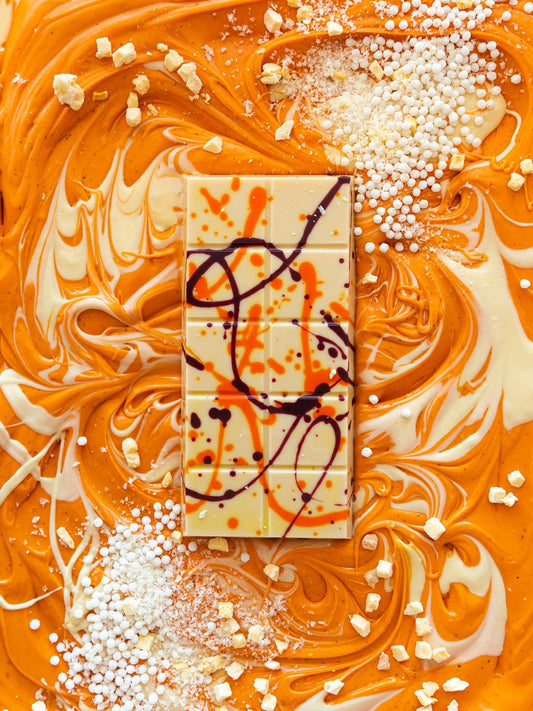


The Complete History of Knafeh: From Ottoman Kitchens to Dubai's Viral Chocolate Bar
The Complete History of Knafeh: From Ottoman Kitchens to Dubai's Viral Chocolate Bar
A thousand-year journey through the Middle East's most beloved dessert — and how one Dubai chocolatier transformed it into a global obsession.
There is a dish so ancient that it predates the Ottoman Empire, so beloved that entire cities claim ownership of it, and so electrically alive on the palate that a single bite can silence a table full of people. That dish is knafeh. And right now, in the twenty-first century, it is having the most improbable second act of any food in history: reborn as a viral chocolate bar, worshipped by millions of people who couldn't have told you what kataifi pastry was twelve months ago.
This is the story of knafeh. Not just the version you know — the glossy, Instagram-perfect chocolate bar that FIX Dessert Chocolatier sent to every corner of the planet — but the one that begins a thousand years ago in a Levantine kitchen, where someone, whose name history has not recorded, first thought to press shredded wheat and fresh cheese together over fire and call it something extraordinary. It is a story about trade routes and royal courts, about Ottoman expansion and the slow migration of flavour across continents, about the particular genius of the Palestinian city of Nablus, about Dubai's appetite for reinvention, and about the remarkable accident of virality that turned a handcrafted chocolate bar into one of the most-watched food videos in the history of TikTok.
If you have bitten into a Can't Get Knafeh of It bar — felt that first clean snap of Belgian chocolate give way to a filling that somehow crackles, creams, and melts all at once — then you have, without knowing it, tasted a thousand years of culinary history. This is where that history begins.
The Ancient Origins: Cheese, Wheat, and the Levant
To understand knafeh, you need to travel back to the tenth century — to a world without refrigeration, without standardised recipes, and without the global food media that would eventually amplify a dessert made in a Dubai kitchen into something approaching a cultural phenomenon. You need to understand a landscape where food was utility as much as pleasure: where wheat was survival, cheese was a means of preserving precious milk proteins, and sweetness was the province of honey because cane sugar, though known, was still a luxury traded at extraordinary expense along the caravan routes of the ancient world.
The earliest documented reference to a dish resembling knafeh comes from medieval Arab culinary texts. The tenth-century writer Ibn Sayyar al-Warraq, whose monumental cookbook Kitab al-Tabikh — literally "The Book of Dishes" — catalogues hundreds of recipes from the Abbasid court in Baghdad, describes preparations involving shredded pastry and sweet fillings that bear a recognisable ancestor's resemblance to the knafeh we know today. These early preparations were less the precise confection of modern knafeh and more a broad category of technique: layering fine dough, sweet filling, and often a syrup or honey in ways designed to create contrast between the crispy and the yielding, the savoury and the sweet.
This early culinary tradition sat at the intersection of three ancient food cultures that collided and merged across the Fertile Crescent: the Persian tradition of elaborate layered pastries sweetened with rosewater and fruit; the Levantine tradition of fresh white cheese preserved in salt and brine; and the Arab tradition of cooking grain products over open flame until bronzed and fragrant. What we now call knafeh is, at its deepest root, the child of all three.
The word itself tells us something. The Arabic كنافة (knāfah) most likely derives from a root meaning "to feel close to" or "to take care of" — suggesting, from the very beginning, a food of warmth and comfort rather than mere sustenance. This is a dish conceived as an act of generosity, of care, of the particular intimacy that exists between a cook and the people they feed. That quality, we would argue, is present in every version of knafeh that has ever been made well — including, in its own way, the FIX bar that carries the tradition into the twenty-first century.
The dish appears in multiple variants across the medieval Arab culinary canon, including mentions in the thirteenth-century Egyptian text Kitab Wasf al-Atima al-Mutada (A Description of Familiar Foods), confirming that by the high medieval period, some form of this dessert was well-established across much of the Arab world.
Food historians have noted that the spread of knafeh through the medieval Levant roughly tracks the expansion of sheep and goat herding as the dominant pastoral activity of the region — a pattern that makes sense, since the cheese at the heart of the dish is made from the milk of those animals. Knafeh is, in this sense, a product of landscape as much as of culture.
The critical innovation that transformed a general category of sweet pastry into the specific dish we call knafeh was the introduction of white cheese as the primary filling. Most food historians locate this development in the Levant — the geographical corridor that runs from modern-day Turkey through Syria, Lebanon, and Palestine down to Egypt — during the medieval period. The Levant was, and remains, a land of remarkable cheesemaking traditions. Fresh white cheeses, semi-soft and mild, with that slightly elastic, pull-apart texture that modern diners associate with mozzarella or ricotta (though the Levantine varieties have their own distinct character), were produced throughout this region for centuries.
The particular genius of combining this cheese with shredded or semolina-based pastry was not purely aesthetic, though the resulting dish is beautiful. It was practical. The fat in the cheese prevented the pastry from becoming bitter as it cooked over flame. The cheese filled the dish with protein and caloric density that pure sweet pastry could not provide. The contrast — the slight salt of the cheese against the deep sweetness of the syrup poured over the finished dish — created the kind of flavour complexity that is easy to eat in enormous quantities without quite understanding why you cannot stop.
Knafeh, from the very beginning, was a food designed to be irresistible. It simply took a thousand years for the rest of the world to find out.
The Role of Sugar: A Luxury Becomes Everyday
One of the pivotal moments in the history of knafeh — and indeed in the history of Middle Eastern pastry broadly — was the gradual democratisation of cane sugar. During the early medieval period, sugar was precious: traded along the same routes as silk and spices, reserved for the tables of caliphs and wealthy merchants. The sweet syrup that defines knafeh's flavour profile, that heavy attar or simple syrup perfumed with rosewater and sometimes orange blossom water, would have been beyond the means of ordinary households in the tenth century.
The Crusades, often discussed in terms of military and religious history, were also one of the most significant transfers of culinary knowledge between the Islamic world and medieval Europe. Among the things that flowed in both directions were refined techniques for working with sugar. As cane cultivation expanded across the Mediterranean basin — in Cyprus, Sicily, Andalusia, and Egypt — sugar became incrementally more available. By the time the Ottoman Empire had consolidated its control over much of the sugar-producing world in the fifteenth and sixteenth centuries, the transformation was complete: sugar had moved from luxury item to cooking staple across the Middle East, making dishes like knafeh not just the province of royal kitchens but of every market stall and family celebration throughout the Levant.
This democratisation of sweetness was the moment knafeh truly became a people's food. No longer reserved for the tables of the powerful, it could now be prepared in home kitchens and sold by street vendors, its price driven by the labour of making the pastry rather than by the scarcity of its sweetener. It is the same arc that chocolate followed in Europe: from an aristocratic luxury to a mass-market pleasure, and in that journey, from rarity to ubiquity, finding its full cultural meaning.
There is a beautiful historical irony in the fact that these two trajectories — the democratisation of knafeh through the availability of sugar, and the democratisation of chocolate through the industrialisation of cocoa processing — have now converged in a single object: a chocolate bar that carries the flavours and textures of knafeh to anyone in the world who wants them. History does not repeat itself, but sometimes it rhymes with extraordinary precision.
The Ottoman Empire and the Spread of Knafeh
If the medieval Arab world created knafeh, it was the Ottoman Empire that standardised it, refined it, and sent it across half the world in the luggage of soldiers, administrators, and merchants. The Ottomans — whose empire at its height stretched from the gates of Vienna to the Persian Gulf, encompassing territory that today constitutes more than twenty sovereign nations — were, among many other things, extraordinarily serious about pastry.
The imperial kitchen at Topkapi Palace in Istanbul, known as the Matbah-ı Âmire, was one of the most sophisticated culinary operations in human history. At its peak in the sixteenth century, it employed over a thousand staff and fed between ten and fifteen thousand people daily, from the sultan and his household down through the janissary corps to the servants and labourers who kept the palace running. Within this kitchen, a cadre of specialist pastry cooks — the helvacılar, or confectioners — were responsible for producing the sweet dishes that defined Ottoman court cuisine. It was within this tradition that knafeh, arriving in Istanbul from the conquered territories of the Levant, was elevated, standardised, and eventually sent back out into the empire in refined form.
"The Ottoman pastry kitchen did not merely preserve the food traditions of the territories it conquered. It absorbed them, transformed them, and sent them back out across a world that stretched from Vienna to the Persian Gulf."
— Food historian Charles Perry, on medieval Arab and Ottoman culinary exchangeThe Ottoman contribution to knafeh was primarily one of technique and standardisation. The empire's pastry cooks developed and refined the two primary dough types that define knafeh to this day: the kataifi form, using the fine vermicelli-like shredded pastry (called kadayıf in Turkish) that is now most closely associated with the version popularised by FIX's Can't Get Knafeh of It; and the semolina form, using a dough made from fine-ground semolina that creates a smoother, denser outer layer. Both techniques required skill, consistency, and specific tools — including the distinctive copper pan over which knafeh is traditionally cooked, which became standardised across the empire's pastry-making tradition.
As the Ottoman Empire expanded and contracted over five centuries, knafeh travelled with it. It found its way into the food cultures of what are now Turkey, Greece, the Balkans, Egypt, the entire Levant, and the Arabian Peninsula. Each territory absorbed the dish and adapted it to local tastes, local cheese traditions, and local flavour preferences, creating the extraordinary diversity of knafeh variants that exist across the Middle East and Eastern Mediterranean today.
The Palace Kitchens and the Codification of Sweet Pastry
One of the most significant Ottoman contributions to knafeh's history was the creation of what food historians have called a "grammar of pastry": a coherent set of techniques, ingredient combinations, and flavour profiles that gave the family of dishes that includes knafeh, baklawa, and their relatives a recognisable identity across an enormous geographic and cultural span. The Ottoman court kitchen is where we see the first evidence of knafeh being prepared with the scrupulous attention to technique that characterises the best versions of the dish today.
Key among these technical contributions was the refinement of the syrup — the attar or qater that is poured over the hot knafeh immediately after it comes from the fire, penetrating the pastry and pooling with the molten cheese beneath. Ottoman confectioners understood, with the intuitive precision of experienced practitioners, that the ratio of sugar to water, the addition of lemon juice to prevent crystallisation, and the precise moment of application — when the knafeh was still at its maximum heat, capable of absorbing the syrup fully — were the variables that separated transcendent knafeh from merely competent knafeh. This tradition of precision is one that the best knafeh makers in Nablus, Damascus, and Dubai maintain to this day.
The Ottomans also institutionalised the role of specialist knafeh makers within the urban economy. In the great cities of the empire — Cairo, Damascus, Aleppo, Jerusalem, and Constantinople itself — dedicated shops called kanafeci in Turkish and similar names in Arabic existed for the sole purpose of producing and selling knafeh. These were not general pastry shops but specialists: craftspeople whose entire professional identity was bound up with a single dish, who passed their knowledge through family lines and master-apprentice relationships across generations. The concentration of expertise that this specialisation enabled is one of the reasons why knafeh in its heartland cities achieves a quality that is extraordinarily difficult to replicate elsewhere without similar levels of dedicated practice.
This model of deep specialisation is something that FIX Dessert Chocolatier has, in its own way, replicated. The FIX team does not make a range of generic confections and happen to include a knafeh-inspired bar among them. They have made the flavours and textures of Middle Eastern dessert tradition their singular focus, and the depth of knowledge and precision that focus enables is what distinguishes their bars from the many imitators who have appeared since the viral moment.
Dishes resembling knafeh appear in tenth-century Arab culinary manuscripts from the Abbasid court in Baghdad, described by food writer Ibn Sayyar al-Warraq in the landmark Kitab al-Tabikh.
Medieval Egyptian texts document knafeh as an established dish. The city of Nablus begins developing the style that will bear its name for centuries. The semolina variant gains prominence in the Palestinian tradition.
The Ottoman imperial kitchen elevates and standardises knafeh, spreading refined versions across an empire spanning three continents. Kadayıf (kataifi) pastry technique is perfected in Istanbul's Topkapi kitchens.
Dedicated knafeh shops appear throughout major Ottoman cities. Nablus emerges as the undisputed capital of the finest knafeh, renowned across the empire for the quality of its Nabulsi cheese and the craft of its makers.
Dubai's extraordinary cosmopolitan food culture brings knafeh into contact with global chocolate and luxury dessert traditions. Artisan chocolate making takes root in the UAE, setting the stage for a historic reinvention.
The original Dubai chocolate bar is born: toasted kataifi, pistachio cream, and Belgian chocolate combine to introduce knafeh's essence to a global audience of millions — years before the world catches on.
A slow-motion video of the bar being broken in half accumulates over a billion views across TikTok and Instagram. "Dubai chocolate" enters the global food lexicon. FIX begins shipping worldwide to meet unprecedented demand.
Regional Variations: A Dish of a Thousand Faces
One of the most compelling things about knafeh — and one of the things that makes it so difficult to define cleanly for an international audience unfamiliar with its full range — is the extraordinary diversity of its regional forms. There is no single "correct" knafeh. What you eat in Nablus is different from what you eat in Cairo. What you eat in Cairo differs from the version in Beirut. What you eat in Damascus is not quite the same as what crosses the border into Turkey as kadayıf. And yet all of these dishes belong to the same family, share the same fundamental grammar of crispy pastry, soft filling, and sweet syrup, and are recognisably cousins to one another.
Travelling through the knafeh traditions of the Middle East is to take a tour through centuries of regional adaptation and local pride — and to understand why the Can't Get Knafeh of It bar, when it first appeared, resonated so powerfully with people from backgrounds across the Arab world. For many of them, that crackle and that sweetness and that specific combination of textures was a taste memory from childhood, transported into a form they had never expected to find.
Each of these variants tells the story of a different set of local conditions — different available cheeses, different climate considerations for serving temperature, different cultural traditions around when and how sweet dishes are consumed — and each has its passionate defenders who will argue, often with great feeling, that their version represents the authentic original. This passion is not mere food chauvinism. It reflects the fact that in the cultures where knafeh is native, the dish carries enormous emotional weight.
It is a food of celebration, of family, of the holy month of Ramadan when families break their fast each evening and the sweet richness of knafeh provides the dramatic counterpoint to a long day of abstinence. It is a food of Eid, of weddings, of the return of a loved one from a long journey. These associations are so deep that the mere smell of knafeh cooking — that specific combination of caramelising pastry and melting cheese, which is unlike anything else — can trigger emotional responses that have nothing to do with hunger and everything to do with memory and belonging.
This is exactly the emotional territory that FIX Dessert Chocolatier understood, perhaps intuitively, when they developed Can't Get Knafeh of It. A chocolate bar that could trigger that memory — that could carry the essence of knafeh into a portable, giftable, internationally shippable form — was not just a novelty product. It was an act of cultural translation, and like all the best acts of translation, it was faithful not to the letter of the original but to its spirit.
The Core Ingredients and What Makes Them Special
To truly appreciate knafeh — in its traditional form and in the chocolate interpretation that FIX has made famous — you need to spend some time with its individual ingredients. This is a dish where quality of component parts is everything. Knafeh made with mediocre ingredients is edible. Knafeh made with exceptional ingredients is one of the transcendent eating experiences available to a human being. The gap between those two things is worth understanding.
The Kataifi Mystique
Of all the ingredients in knafeh, kataifi pastry is the one that most people outside the Middle East have either never encountered or, having encountered it, cannot quite explain. It looks, in its raw form, like a tangle of very fine white threads — something between angel hair pasta and delicate cotton. It is made from a simple batter of flour, water, and a little oil, drawn through a fine sieve or special mold onto a hot metal surface where it cooks almost instantly, producing the threadlike strands that distinguish it from any other pastry in the world.
What kataifi does when cooked is remarkable. Coated in fat and exposed to heat, it transforms from its raw, slightly moist state into something that behaves like a sophisticated structural and textural element: it creates an extraordinarily crispy outer layer that shatters when bitten, producing that sound and sensation that food scientists call "acoustic crunch" — the experience of a food making an audible, pleasurable sound as it is eaten, which research has consistently shown is one of the most significant contributors to the enjoyment of eating. The science of why this is pleasurable is examined more fully later in this piece; for now, it is enough to say that the crunch of well-prepared kataifi is one of the most reliably pleasurable physical experiences that food can provide.
Making kataifi by hand is a dying art. Traditional practitioners use a perforated copper vessel filled with batter, which they rotate over a heated copper plate, allowing fine streams of batter to fall and cook in seconds. A skilled kataifi maker can produce sheets of the pastry continuously, building up layers in a rhythm that looks almost meditative — and which takes years to perfect.
Modern kataifi production has moved almost entirely to industrial processes, where the same principles apply but the equipment is scaled up enormously. Even at industrial scale, however, the quality of kataifi varies significantly: strand diameter, moisture content, and the precise formulation of the batter all affect how the final pastry behaves when cooked and whether it achieves that singular crunch that separates extraordinary knafeh from ordinary knafeh.
FIX sources and processes its kataifi with the same obsessive attention to quality that defines all their ingredient sourcing, toasting it to a precise golden brown before incorporating it into the bar's pistachio filling — ensuring that the crunch survives even the journey from Dubai kitchen to your front door, weeks later, anywhere on earth.
Nabulsi Cheese: The Heart of Traditional Knafeh
The cheese that gives Knafeh Nabulsieh its name and character is Nabulsi, a semi-hard white cheese produced in and around the Palestinian city of Nablus. It is a brine-cured cheese, which means it is stored and aged in salted water — a preservation method that both flavours the cheese and gives it a firm, sliceable texture in its cold state. But put it in heat and something extraordinary happens: it softens rapidly, becoming almost liquid at its centre while retaining enough structure to hold its shape, creating the flowing, stretchy interior that knafeh lovers will recognise instantly as the dish's defining characteristic.
Nabulsi cheese is made from sheep's or goat's milk — sometimes a mixture of both — and its flavour reflects this: slightly gamey, distinctly tangy, with a mineral quality that the milder cow's milk cheeses used in western cooking rarely possess. This distinctive flavour is not incidental to knafeh's taste profile; it is central to it. The slight funkiness of the cheese, the way it pushes back against the sweetness of the syrup rather than simply being subsumed by it, is what gives knafeh its characteristic complexity — the reason that eating it feels like an experience rather than merely a consumption of sugar.
The Pistachio: From Garnish to Star
In traditional knafeh, pistachio appears primarily as a garnish: a scattering of coarsely ground green nuts over the amber surface of the finished dish, providing colour contrast, textural variation, and a hit of bitter nuttiness against the sweetness of the cheese and syrup. In the FIX bar, pistachio has been promoted from supporting role to leading role: the pistachio cream that forms the primary filling is the vehicle through which the richness, the complexity, and the flavour depth of the traditional dish is communicated to the chocolate-bar format.
This promotion was not arbitrary. Pistachio and knafeh have always had a deep affinity that goes beyond mere garnish. The pistachio's flavour profile — intense, resinous, slightly grassy, with a hint of dried fruit — is complex in a way that cuts through the sweetness of the dish and adds depth. Premium pistachios from Aleppo in Syria or from Rafsanjan in Iran have a particular character: a more pronounced green colour, a brighter, more aromatic flavour, and a richer oil content than the commercial pistachios used in most mass-market products. These premium varieties are what the best traditional knafeh makers use, and they are the standard to which FIX aspires in its pistachio cream formulation.
How Traditional Knafeh Is Made: A Step-by-Step Journey
To fully appreciate the feat of engineering that FIX accomplished in encoding knafeh into a chocolate bar — transporting every essential element of the dish's texture, flavour, and emotional resonance into a portable, internationally-shippable format — it helps to understand exactly how the original is made. The process is simple in outline but demanding in execution, requiring the kind of spatial intelligence and temperature awareness that separates a gifted cook from a merely capable one.
Nablus and the City That Claims Knafeh as Its Own
Any serious discussion of knafeh's history must spend significant time in Nablus, a Palestinian city of approximately 200,000 people situated in the northern West Bank, at the foot of Mount Gerizim. Nablus is, by the consensus of virtually every food writer, historian, and knafeh devotee who has addressed the question, the spiritual capital of knafeh. This is not merely local pride. There are substantive, historically grounded reasons why the Nabulsieh variant of knafeh is regarded as the gold standard against which all others are measured.
The most important of these reasons is the Nabulsi cheese itself. Unlike the many cheese traditions of the region that evolved primarily to make use of available milk, the production of Nabulsi cheese became so closely tied to the production of knafeh — the local demand was so consistent and so specific — that the cheesemaking tradition in and around Nablus was shaped by the requirements of the dish. The result is a cheese perfectly engineered, through centuries of selective practice, to perform exactly as knafeh requires: to melt at the right temperature, to stretch in the right way, to possess exactly the right balance of salt and funk to interact with the syrup as intended.
"In Nablus, making knafeh is not a job. It is an inheritance. The copper pans have been used by the same families for so many years that they have worn smooth in exactly the places where hands most naturally rest — a physical record of the generations of makers who came before."
— From a culinary survey of Palestinian food traditionsThe emotional weight that Nablus places on its knafeh tradition is difficult to overstate. In a city that has experienced profound political disruption, economic hardship, and the particular stresses of life in occupied territory, knafeh is not just a dessert. It is an assertion of continuity, of cultural identity, of the persistence of craft and community in the face of everything that would disrupt them. When residents of the Palestinian diaspora around the world taste knafeh from Nablus or from a trusted maker who uses Nabulsi cheese and traditional methods, they are not merely eating. They are performing an act of cultural memory.
It is worth pausing here to note that this emotional depth is exactly what makes the FIX chocolate bar's tribute to knafeh so resonant for the Arab and Muslim diaspora communities who were among its earliest and most devoted fans. Before the bar went globally viral, before the millions of TikTok views and the BBC coverage and the Vogue Arabia features, it was passing through WhatsApp groups in London, New York, and Sydney — being ordered by Arab families who recognised in the bar's name (Can't Get Knafeh of It) not just a pun but a kind of love letter to a food tradition that meant something profound to them.
Nablus has long sought international recognition for Nabulsi cheese as a product of protected geographical origin — similar to the Champagne designation in wine or Parmigiano-Reggiano in cheese. The argument is that the specific combination of local milk, local water chemistry, local climate conditions, and local craft knowledge makes Nabulsi cheese irreproducible elsewhere.
This aspiration towards official recognition reflects a deeper truth about knafeh: that it is not merely a recipe but an ecosystem — a web of relationships between a specific landscape, a specific animal husbandry tradition, specific craft knowledge, and specific cultural practices — that happens to produce one of the world's most extraordinary pastries.
Knafeh in Dubai: Where Tradition Meets Innovation
To understand why Dubai was the city where knafeh was reinvented as a chocolate bar — and not Beirut, not London, not New York, all cities with large Arab populations and thriving food scenes — you need to understand what Dubai is and what it is not. Dubai is not an ancient city. Its old town, the Bur Dubai and Deira districts along the Creek, has a certain weathered charm, but the metropolis that exists today — the skyscrapers, the malls, the restaurant districts, the extraordinary infrastructure of luxury — is essentially a late twentieth and early twenty-first century construction.
What Dubai has that other cities lack is a very particular combination of factors that makes it the most productive possible petri dish for culinary innovation. It has an extraordinarily diverse population: roughly 89% of Dubai's residents are expatriates, representing virtually every nationality on earth. It has enormous concentrations of disposable income at every level of society. It has a physical and regulatory environment that makes opening new food businesses relatively straightforward. And it has a cultural atmosphere that prizes novelty, experience, and the kind of conspicuous quality that photographs well — because, for a city whose brand is built in no small part on its ability to generate awe, food must be part of the show.
The result is a food scene of extraordinary range and vitality. Within a single square kilometre of Dubai's more prosperous districts, you can eat world-class Japanese, Italian, Indian, Lebanese, Peruvian, and Emirati food — and you can eat all of them within an aesthetic context of studied luxury that makes every meal feel like an event. Chefs and food entrepreneurs who come to Dubai find themselves operating within a market that is simultaneously highly sophisticated — the city's residents have eaten at excellent restaurants all over the world and have refined palates — and extremely hungry for novelty, because novelty is part of Dubai's self-image.
The Arabian Gulf's Chocolate Revolution
Parallel to Dubai's food scene revolution was a quieter but no less significant development: the city had become a serious chocolate market. The Gulf's relationship with chocolate had historically been shaped by the region's function as a major trading hub for premium goods from Europe and beyond, and by the Islamic tradition of hospitality in which offering guests fine food and drink — coffee, dates, sweets — is both cultural imperative and social performance. Premium chocolate, particularly from Belgium and Switzerland, had become a standard element of this hospitality culture: beautiful boxes of imported truffles and pralines given as gifts, served at meetings and celebrations, exchanged during Eid and Ramadan.
By the 2010s, Dubai's chocolate culture was sophisticated enough to support not just import retail but genuine local production. Small artisanal chocolate makers began appearing in Dubai's growing artisanal food ecosystem — makers interested not in merely replicating European traditions but in working with local and regional flavours: date caramel, saffron, cardamom, tahini, rose. The city was developing, in other words, a local artisanal chocolate vocabulary. FIX Dessert Chocolatier, founded in 2021, entered this ecosystem at exactly the right moment — and with a product concept that the market had not seen but instinctively understood as inevitable the moment they tasted it.
The Birth of the Dubai Chocolate Bar
The story of how the Dubai chocolate bar came to exist is, like all the best food stories, partly a story of craving. The founders of FIX Dessert Chocolatier were driven by a desire to combine two things they loved — the tradition of Middle Eastern dessert and the global language of premium chocolate — in a way that felt genuinely new rather than merely hybrid. They wanted to make something that would be recognised and celebrated by the Arab communities who had grown up with these flavours, and discovered and adored by the global audiences who had never encountered them.
The conceptual leap — from "the flavour and texture of knafeh" to "what if those flavours and textures lived inside a chocolate bar?" — sounds simple in retrospect. It always does. But simple concepts require sophisticated execution, and the technical challenges involved in translating knafeh into chocolate format were substantial. How do you keep kataifi crispy inside a chocolate bar? The moisture in any filling will gradually soften crispy elements, so the filling formulation had to be constructed to minimise moisture migration. How do you capture the flavour of Nabulsi cheese without including cheese in a product that needs to survive international shipping at ambient temperature? The answer was pistachio cream: a rich, intensely flavoured paste whose nuttiness and slight bitterness plays a similar role to the cheese's funk in the overall flavour composition. How do you create the experience of syrup-soaked pastry in a format where actual syrup would prevent the chocolate shell from setting properly? Very careful calibration of the sugar content in the pistachio cream filling.
"We weren't trying to replicate knafeh inside a chocolate bar. We were trying to capture the feeling of knafeh — the crunch, the richness, the moment when sweet and savoury stop fighting each other and become something completely new."
— FIX Dessert Chocolatier, on the development of Can't Get Knafeh of ItEach of these problems was solved iteratively, through the kind of obsessive recipe testing that separates a product that works from a product that is truly extraordinary. The chocolate shell needed to be thick enough to provide structural integrity and a satisfying snap but not so thick that it overwhelmed the filling. The kataifi needed to be pre-toasted to a specific colour and crunchiness before incorporation. The ratio of pistachio cream to kataifi in the filling needed to be calibrated so that neither element dominated — so that every bite delivered both the creamy richness of the paste and the crackle of the pastry simultaneously. These are not decisions that can be made theoretically. They can only be made by making, eating, adjusting, and making again.
How FIX Created Can't Get Knafeh of It
Understanding what FIX built requires understanding what distinguishes a truly excellent chocolate bar from a merely competent one. The world has thousands of chocolate bars. The overwhelming majority of them are competent products: they are sweet, they are edible, they provide a hit of sugar and fat that satisfies the basic impulse that drives chocolate consumption. But very few of them do anything more than that. Very few of them are the kind of object that a person picks up, takes one bite of, and immediately needs to tell someone about.
What separates the extraordinary from the competent is almost always texture. Flavour alone is not enough — the most interesting flavour profile in the world, presented in a monotextural format, will bore you by the third bite. It is the interaction of different textures, the way a mouthful changes as it moves through chewing and melting and dissolving, that keeps a chocolate bar interesting. Consider what happens when you bite into Can't Get Knafeh of It:
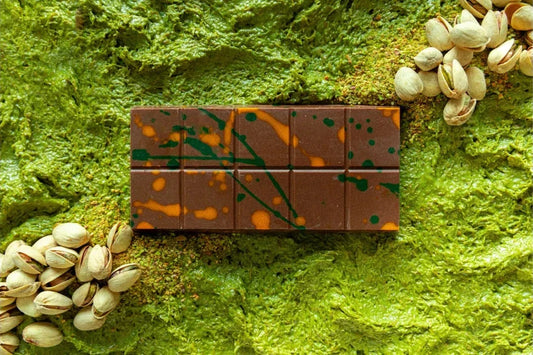
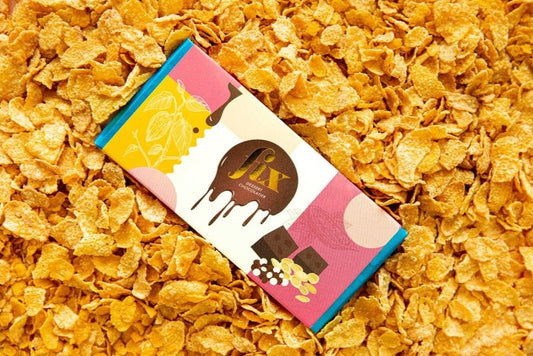
First, the snap of the Belgian chocolate shell — immediate, clean, satisfying. This is a proprietary pleasure: the snap of chocolate is produced only when it has been correctly tempered, when the cocoa butter crystalline structure is in the specific Beta V formation that gives premium chocolate its gloss, its hardness, and that characteristic sound. The FIX bar's snap is authoritative. Then, immediately beneath the shell, the filling: pistachio cream and toasted kataifi in a ratio that has been calibrated to deliver both elements in every bite. The cream hits first — rich, slightly sweet, with that intensely grassy, nutty pistachio flavour that is so different from any other nut — and then, a fraction of a second later, the kataifi. The crunch is extraordinary: sudden, total, deeply satisfying. And then the whole thing is melting into a unified flavour that is neither purely chocolate nor purely knafeh but something new — something that draws from both traditions and exceeds either.
| Element | Traditional Knafeh | Can't Get Knafeh of It Bar |
|---|---|---|
| Outer layer | Kataifi or semolina pastry, toasted golden in a copper pan | Premium Belgian chocolate shell (milk or dark), tempered to a crisp snap |
| Primary filling | Nabulsi or akawi white cheese, desalted and melted | Pistachio cream — captures the richness and slight savouriness of the cheese |
| Texture element | The kataifi itself (outer layer) | Pre-toasted kataifi strands folded through the pistachio cream filling |
| Sweet element | Rosewater and orange blossom sugar syrup, poured hot over the finished dish | The sweetness of the Belgian chocolate and the natural sugars in the pistachio cream |
| Finish / garnish | Crushed pistachios scattered over the top | Pistachio flavour embedded throughout the filling |
| Service | Immediately, while hot and the cheese is still molten | At room temperature, ships worldwide from Dubai |
The Science of the Perfect Crunch
Food scientists have spent considerable energy trying to understand why certain textures are more pleasurable than others — and what it is about the specific crunch of well-made kataifi, or the snap of correctly tempered chocolate, that produces such reliable and intense pleasure in the people who experience it. The findings are illuminating, and they help explain why Can't Get Knafeh of It works as powerfully as it does.
The crunch of food, in scientific terms, is a mechanical failure event: the sudden collapse of a rigid structure under applied force. This failure propagates through the material rapidly and produces sound waves in both the food itself and the bones of the jaw and skull — sounds that travel directly to the inner ear and are processed as part of the overall eating experience. Research conducted at the University of Oxford and elsewhere has demonstrated that the loudness, pitch, and duration of these failure sounds are directly correlated with pleasure ratings for crunchy foods: louder, higher-pitched, and more sudden crunches are consistently rated more pleasurable than quieter, lower-pitched, or more gradual ones.
Kataifi, when correctly prepared, produces crunch sounds in the optimal range: very loud relative to other food crunch sounds, reasonably high in pitch, and extremely sudden — the collapse of the pastry structure is almost instantaneous, producing what acoustics engineers call a "transient" rather than a "continuous" sound event. This transient character is what distinguishes it from the crunch of, say, a biscuit, which tends to be softer, longer in duration, and lower in amplitude. It is closer, in acoustic terms, to the snap of correctly tempered chocolate — which helps explain why the combination of the two, in a FIX bar, produces such an intense double-crunch experience.
Maintaining Crunch in a Filled Chocolate Bar
One of the most significant technical challenges FIX had to solve in developing Can't Get Knafeh of It was the problem of moisture migration. In any filled confection, water moves from wetter elements to drier elements over time — a process that eventually destroys the crunchiness of any crispy element embedded in a moist filling. This is why commercially made confections with crispy elements often feel stale within days of production: the filling has transferred moisture into the crispy layer, softening it.
FIX's solution involved two parallel strategies. First, the kataifi is toasted to a much lower moisture content than would be required for a fresh-served knafeh — essentially, the strands are dried as well as browned, reducing the amount of moisture they can subsequently absorb from the pistachio cream. Second, the pistachio cream itself is formulated at a relatively low water activity, meaning there is less free water available to migrate. Together, these strategies give the bar a shelf life of several months during which the kataifi retains meaningful crunch — a real, satisfying crunchiness that is present in every bite, even if it is not quite the explosive fresh-from-the-copper-pan crunch of traditional knafeh.
The Viral Moment: How Knafeh Chocolate Conquered Social Media
There is a specific type of video that most people credit with starting the global Dubai chocolate bar phenomenon. Posted in 2024 by food content creators in Dubai, it showed hands breaking open a FIX bar — the camera close enough to see the sheen of the chocolate shell, hear the snap — and then the filling revealed: glossy pistachio cream studded with golden kataifi strands, stretching as the two halves separated. Within days of the first videos, they had millions of views. Within weeks, tens of millions. Within months, the content had crossed every language barrier on the internet and become part of TikTok's food canon.
Why did it go so completely, utterly viral? Food marketing professionals and social media analysts have offered a range of explanations, and the truth probably incorporates all of them.
The ASMR Effect
The videos trigger multiple ASMR (Autonomous Sensory Meridian Response) responses simultaneously. The crack of the chocolate, the visual of the filling stretching, the close-up texture of the kataifi — these are deeply satisfying stimuli for a very large proportion of the population. ASMR food content has been one of the fastest-growing categories on social media for several years; the FIX bar videos were essentially perfectly crafted ASMR pieces, though not designed to be. The accidental perfection of the content — the unforced quality of its pleasure triggers — is part of what made it feel authentic rather than produced.
The Novelty Factor
The filling was unlike anything in the established vocabulary of western chocolate bars. Milk chocolate bars with nougat, caramel, nuts — these are known quantities. A bar with a filling that is simultaneously creamy, crunchy, gold-green in colour, and clearly connected to a non-European food tradition was genuinely unexpected. Novelty drives sharing, especially on platforms where the currency is the ability to show your network something they haven't seen. The FIX bar was something nobody had seen before — and that fact was legible in a three-second video with no explanation required.
The Desirability Gap
The bar was, initially, almost impossible to buy if you were not in Dubai. FIX operated as a local brand serving the UAE market; international demand was an accident, not a plan. The extraordinary difficulty of obtaining the bar outside the UAE — the waiting lists, the sold-out notices, the premium prices charged by grey-market resellers — created exactly the conditions of artificial scarcity that make a product feel more valuable and more share-worthy. People were posting about the bar partly because they wanted it and couldn't have it, and desire is one of the most contagious emotions on social media.
Knafeh Around the World: From Levantine Tradition to Global Craving
One of the most remarkable consequences of the Dubai chocolate bar's viral success is what it has done for awareness of knafeh as a dish in its own right. Before the FIX bar went viral, knafeh was well known within Arab, Turkish, and broader Middle Eastern communities globally, and had some currency in western food media as an "interesting" Middle Eastern dessert. After the viral moment, millions of people who had never eaten knafeh began searching for it, reading about it, asking where they could try the real thing.
This spillover effect has been measurable and significant. Google Trends data for searches related to "knafeh," "kunafa," and "kataifi" show sharp increases beginning in mid-2024 and sustained at elevated levels well into 2026. Middle Eastern bakeries and sweet shops in western cities that have been serving knafeh for decades to their own communities found themselves suddenly besieged by customers who had learned about the dish through a chocolate bar. Nablus's reputation — always known within the Arab world but essentially invisible to western food media — began appearing in mainstream food publications for the first time.
The FIX bar is, in this sense, not just a confection but a vehicle: a portal through which millions of people have begun to explore a culinary tradition they would otherwise have encountered only by accident or not at all. This is one of the most interesting things that food can do — not simply feed people but introduce them to the cultures and histories that food carries within it.
The Imitation Economy and the Question of Authenticity
The extraordinary commercial success of Can't Get Knafeh of It inevitably attracted imitators. Within months of the bar going viral, dozens — and then hundreds — of copycat products appeared across markets from Germany to the United States, many claiming to be "the" Dubai chocolate bar or the "original" pistachio chocolate. Most of these products shared the basic concept — chocolate bar, pistachio filling, kataifi — but differed enormously in quality of execution. Some were excellent products in their own right; many were pale shadows, with rubbery chocolate, weak pistachio flavour, and a kataifi element that had been soft since the day of manufacture.
This proliferation of imitations raised genuine questions about authenticity — questions that the knafeh tradition itself can help answer. Knafeh has always had its imitations. Every city that developed a knafeh tradition produced a local version that claimed superiority over its rivals. The answer that the tradition has arrived at, over centuries, is this: authenticity in knafeh is not purely a matter of geography or recipe. It is a matter of intention, craft, and quality of ingredient. A knafeh made with care, with excellent cheese, with precisely toasted kataifi, with a syrup balanced to perfection, made anywhere in the world by someone who understands what they are making and why — is more authentically knafeh than a version produced carelessly in Nablus itself. The same standard applies to the FIX bar, and it is the standard by which FIX succeeds where its imitators fall short.
The Cultural Significance of Knafeh Today
In a world where food has become increasingly globalised — where the same fast food brands, the same coffee shop chains, the same supermarket products appear in cities on every continent — knafeh represents something precious: a food that is genuinely, specifically, irreducibly of its place and culture, that carries within it a weight of history and meaning that cannot be flattened by the processes of globalisation.
For Arab communities worldwide, knafeh is a touchstone. It appears at Ramadan iftar tables and Eid celebrations, at weddings and funerals, at family gatherings that span continents. Palestinian families in the diaspora make it from memory, attempting to replicate the versions of their grandparents' cities using whatever approximations of Nabulsi cheese and kataifi they can source locally. Lebanese families argue about whether theirs is superior to the Palestinian version. Egyptian families insist on their konafa as a distinct tradition worthy of separate consideration. Syrian families miss the knafeh of Damascus in a way that is indistinguishable from missing Damascus itself.
Food is how we carry home with us when we cannot go back to it. And knafeh, perhaps more than almost any other Middle Eastern dish, carries the specific emotional charge of home, of childhood, of the particular sweetness of memory. The fact that a chocolate bar now carries some of that charge into the wider world — that millions of people who had never been to Nablus or Damascus or Beirut now associate that crackle and that creaminess with something desirable, something worth seeking out — is not a diminishment of the tradition. It is an amplification of it.
The cultural significance of knafeh in its heartlands has, if anything, been increased by its global visibility. Cities in the Arab world that were already proud of their knafeh traditions find that pride newly validated by international attention. Young Arabs in the diaspora, who might previously have felt ambivalent about a dessert that seemed "ethnic" by the standards of their adopted cultures, now find it being celebrated by food media and sought out by people from every background. Knafeh has gone from being something that Arab families made in private to something that the world wants to understand — and that shift in status is one that communities with deep traditions in the dish have, by and large, welcomed.
Knafeh vs Kunafa: The Great Naming Debate
Before concluding, it would be an omission not to address what may seem a trivial question but which produces surprisingly strong feelings among those who care about the dish: what, exactly, is the correct spelling and pronunciation of the word?
The Arabic كنافة is romanised in different ways depending on the dialect of the speaker and the conventions of the language being written. Knafeh is the most common Lebanese and Palestinian romanisation, reflecting the pronunciation in those dialects. Kunafa is common in Egyptian usage and is the form that has become most widespread in English-language media and menus — partly because the spelling is more phonetically intuitive for English speakers who might otherwise stress the wrong syllable. Kanafeh, künefe, kadayıf — these are Turkish and variant Levantine transliterations of the same or closely related words.
FIX Dessert Chocolatier's decision to use "Knafeh" in their bar's name (Can't Get Knafeh of It) is deliberate: it roots the product in the Levantine tradition most closely associated with the finest versions of the dish, signals cultural specificity rather than generic Middle Eastern-ness, and sounds right to the ear of anyone who has eaten knafeh in Dubai's Lebanese and Palestinian restaurant culture, where the dish is most commonly encountered. The pun embedded in the name — can't get enough of it — also works better with this spelling than with any of the alternatives. Details matter.
The right answer to the naming question, for our purposes, is simple: all of these are correct, all of them refer to the same extraordinary family of dishes, and the only truly important thing is that you eat some of it as soon as possible. Whether you call it knafeh, kunafa, kanafeh, or künefe, you are reaching for the same ancient pleasure — and the FIX bar is now the easiest way to reach it.
Pairing Knafeh Chocolate with Drinks: A Complete Guide
Like any complex confection, the Can't Get Knafeh of It bar reveals different aspects of itself depending on what you drink alongside it. This is not a trivial consideration — the right pairing can genuinely transform the experience of eating a complex food, bringing forward flavour notes that are otherwise subdued and providing contrast that makes both the food and the drink more enjoyable than either would be alone. Below are the pairings that the FIX team has found most rewarding, and the reasons why each works.
Arabic Coffee (Qahwa)
The traditional pairing, and for good reason. Qahwa — the pale, lightly roasted Arabic coffee flavoured with cardamom and sometimes saffron — has been served alongside knafeh in the Levant and Gulf for centuries. Its bitterness and aromatic complexity provide the perfect foil for the sweetness of the dish, while the cardamom in the coffee echoes the floral, aromatic elements of the rosewater and orange blossom in traditional knafeh. With the FIX bar, qahwa also picks up the darker notes of the Belgian chocolate and amplifies the pistachio flavour through contrast: bitter coffee makes the mild, creamy nuttiness of pistachio taste richer and more pronounced. If you can only try one pairing, try this one.
Espresso
For those without access to qahwa, a well-made espresso — short, intense, slightly acidic — performs a similar role. The acidity of espresso interacts with the fat of both the chocolate and the pistachio cream to create a temporary emulsification on the palate that makes the flavours seem more integrated and harmonious. The bitterness provides the same contrast function as Arabic coffee. Do not use sweetened coffee with this bar; the added sugar fights the bar's own sweetness rather than complementing it. Black espresso, or at most a small amount of unsweetened warm milk, is the correct accompaniment.
Black Tea with Mint
The Levantine combination of heavily sugared black tea with fresh mint, served in small glasses, is another traditional pairing for sweet pastries and works beautifully with the FIX bar. The tannins in the tea cut through the fat of the chocolate and pistachio cream, effectively cleansing the palate between bites and making the crunch of the kataifi feel more pronounced each time. The mint adds a fresh herbal element that contrasts interestingly with the deep, roasted flavour of the toasted kataifi. Use a strong black tea — Ceylon or Assam — rather than a more delicate variety, and brew it properly strong before adding the mint.
Rosewater Lemonade
A non-traditional but surprisingly effective pairing. The floral note of rosewater in the lemonade echoes the syrup that flavours traditional knafeh, creating a sense of continuity between drink and confection. The acidity of the lemon provides contrast to the richness of the bar. This pairing works particularly well with the milk chocolate version of the bar rather than the dark chocolate variant, where the lemonade's sweetness can seem to compete with the bar's own flavour profile. For best results, use a homemade lemonade with fresh lemon juice and a very light hand with the rosewater — a few drops is enough; more becomes cloying.
The Future of Knafeh-Inspired Desserts
If the history of knafeh teaches us anything, it is that this is a food with an extraordinary capacity for reinvention without loss of identity. Every time it has been adapted — by the Ottomans, by regional variations across the Middle East, by the Lebanese diaspora in western cities, by FIX in Dubai — something new has been made without the original being destroyed. The Knafeh Nabulsieh still exists in Nablus as it always has. The Lebanese ashta version still exists in Beirut. The Egyptian konafa still exists in Cairo. And now a version of knafeh's spirit lives inside a chocolate bar that ships from Dubai to a hundred countries.
The next generation of knafeh-inspired innovation is already visible in the creative food scenes of Dubai, London, New York, and Sydney. Pastry chefs are incorporating kataifi into wedding cakes and fine-dining desserts. Ice cream makers are folding toasted kataifi into pistachio ice cream to create knafeh-inspired sundaes. Donut shops are filling their pastries with pistachio cream and kataifi. The viral success of the FIX bar has not exhausted the creative possibilities of knafeh — it has opened them up, introducing a global audience of creative food professionals to an ingredient and a concept that they are now finding their own ways to interpret.
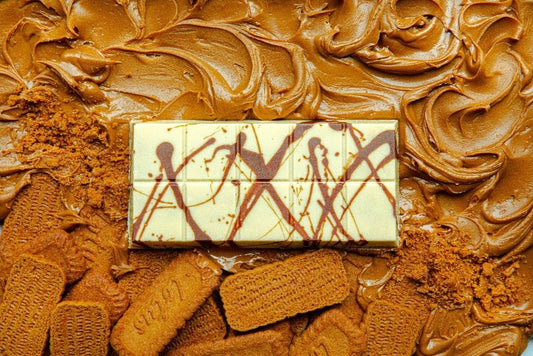
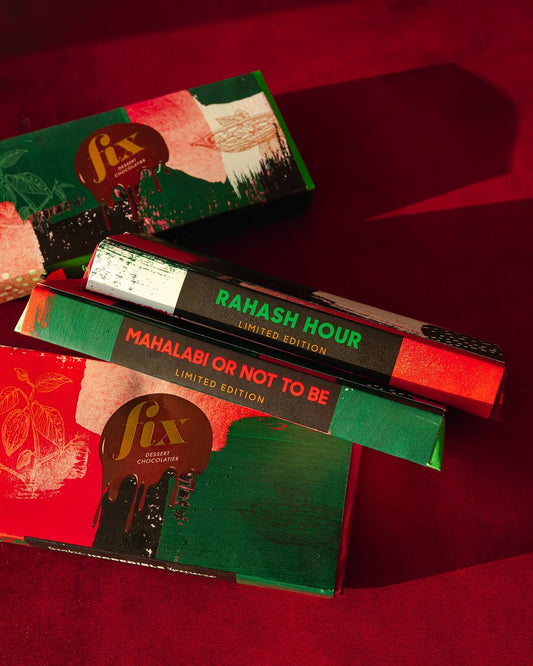
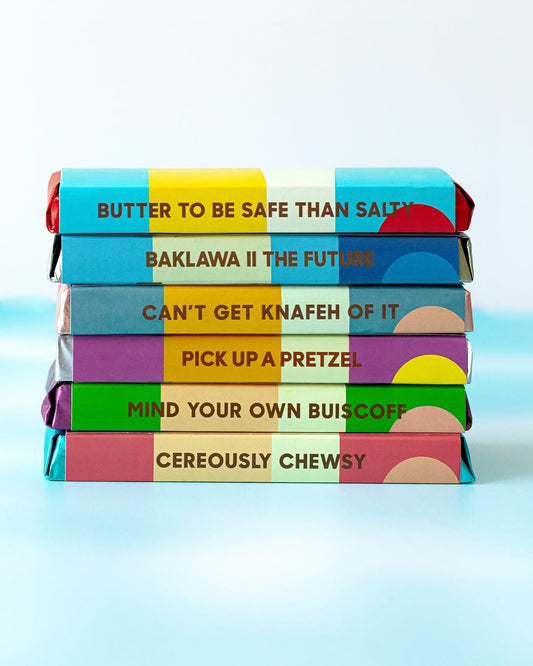
FIX itself has not stood still. The bar that started it all has been joined by a growing family of hero bars, each one drawing on a different Middle Eastern dessert tradition — baklawa, mahalabi, speculoos — and applying the same philosophy of respectful reinvention. Each new bar is an argument that the culinary heritage of the Middle East is not a museum piece but a living tradition, capable of producing new forms without losing the depth and meaning of the old ones. The Baklawa 2 The Future bar carries the flavours of the nut-and-honey pastry that predates even knafeh itself. The Mahalabi or Not to Be bar brings the delicate milk pudding of the Arab world into chocolate format. Honey I'm Comb encodes the ancient practice of honeycomb confectionery into a modern bar with the same attention to textural drama that defines Can't Get Knafeh of It.
What FIX has built, in four years of operation, is not a chocolate company that happens to use Middle Eastern flavours. It is a culinary bridge — an object that allows a global audience to encounter, understand, and fall in love with a tradition that has been feeding people and carrying cultural meaning for a thousand years. That is an extraordinary thing to build in any time. It is an especially extraordinary thing to build in the age of social media, when food can travel at the speed of a swipe and a tradition can find a new audience overnight.
Why This History Matters
We began this piece with a simple proposition: that inside every FIX chocolate bar, there is a thousand years of culinary history. We hope, having read this far, that proposition feels both more specific and more true than it did at the start.
Knafeh's history is not a curiosity to be noted and filed away. It is the context that gives the taste of Can't Get Knafeh of It its full meaning. When you bite into the bar and the kataifi shatters and the pistachio cream blooms and the Belgian chocolate melts over all of it — you are tasting, in some real sense, the cooking traditions of the Abbasid court and the Ottoman imperial kitchen and the specialist makers of Nablus and the extraordinary creative energy of a Dubai chocolatier who looked at a thousand-year-old dessert and asked: what if?
You are tasting a conversation between centuries. And that, we would argue, is worth knowing about.
If this article has made you curious about the other dessert traditions behind the FIX hero bars — the baklawa that inspired Baklawa 2 The Future, the mahalabi that lives in Mahalabi or Not to Be, the honeycomb tradition that FIX encoded in Honey I'm Comb — we will be writing those stories too. The Middle East is one of the world's great food cultures, and its desserts are among its greatest achievements. We are, at FIX, proud to be part of the conversation about what those traditions can become.
Can't Get Knafeh of It — the original Dubai chocolate bar. Handcrafted in Dubai, shipped fresh to your door. Premium Belgian chocolate, pistachio cream, toasted kataifi. One bite, a thousand years of history.
Shop the Original Bar Try a Single Bar First